In a Globalized Business Environment, a stable and professional communication tool is not only a bridge for connectivity but also the cornerstone of a company’s image and efficiency. As traditional tools like Skype phase out, the market demand for professional cloud communication platforms is growing. Among numerous options, IntBell and QUO (formerly OpenPhone) are two frequently mentioned products with distinctly different positioning.
This article will provide an in-depth analysis of these two platforms to help you make an informed choice based on your business needs.
I. Core Positioning: Global Communication Expert vs. North American Team Collaboration Tool
The fundamental difference between the two lies in their design intent and target markets.
IntBell: Enterprise-Grade Global Cloud Communication Platform
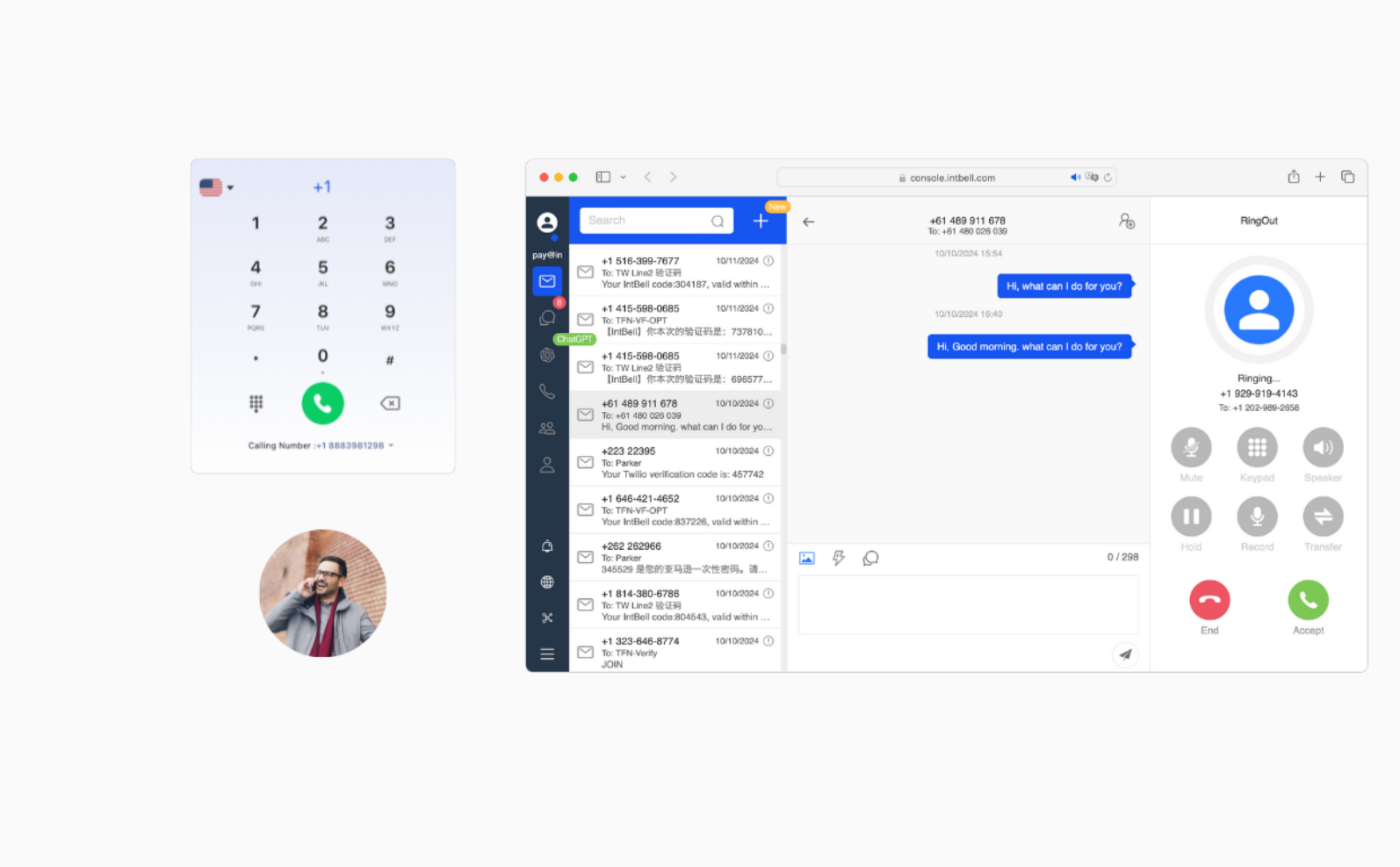
Since its inception, IntBell has targeted the needs of global enterprise communication. Its core value is to help enterprises establish localized professional communication capabilities in any target market at extremely low costs. Whether obtaining a U.S. number to negotiate with Silicon Valley clients or using a UK number to serve the European market, IntBell aims to eliminate geographical and cost barriers in international communication. Its functional design centers on “global coverage,” “transparent costs,” and “business professionalism.”
QUO (Formerly OpenPhone): Team Business Phone Focused on the North American Market
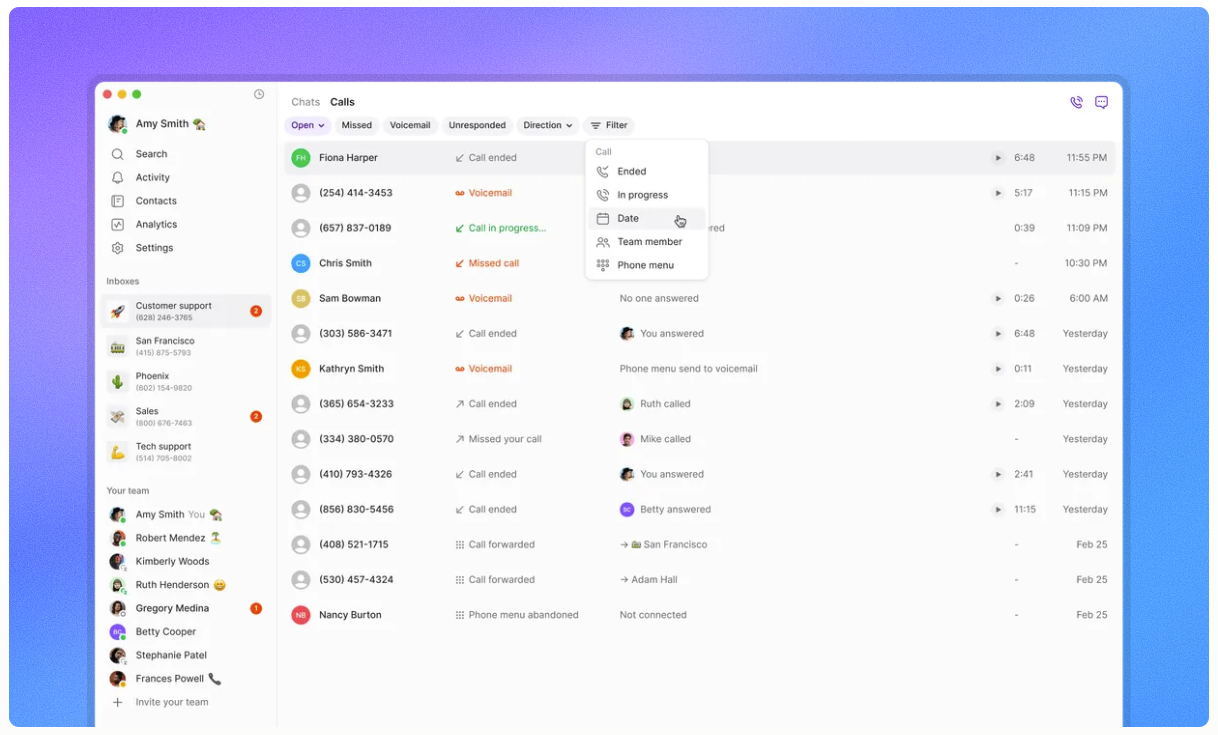
Inheriting from OpenPhone, QUO’s design philosophy focuses more on providing small and medium-sized enterprises (SMEs) and startup teams in North America with a simple, easy-to-use, and feature-integrated business phone system. It excels in handling scenarios such as internal team call distribution, voicemail transcription, and SMS collaboration, with deep integration into North America’s mainstream business ecosystem (e.g., Slack, Salesforce). Its core goal is to improve team communication efficiency rather than achieving global number coverage.

II. Multi-Dimensional Detailed Comparison
To visually illustrate the differences, we compare the two platforms across the following key dimensions:
| Comparison Dimension | IntBell | QUO (Formerly OpenPhone) |
|---|---|---|
| Core Positioning | Global enterprise communication and client connectivity | North American team internal collaboration and business calls |
| Core Advantages | Extensive global coverage, transparent costs, designed for cross-border business | Excellent user experience, in-depth team collaboration features, robust North American localization |
| Coverage Scope | Over 230 countries and regions, with strong coverage in emerging markets such as the Middle East and Africa | Mainly concentrated in the U.S. and Canada, with limited global coverage |
| Number Resources | Offers local numbers, toll-free numbers, and mobile numbers across multiple countries, supporting fast activation (e.g., U.S., Canada, UK, and Australia numbers can be activated within 2 hours) | Focuses on local numbers in the U.S. and Canada |
| Pricing Model | Pay-as-you-go with low call rates (international calls as low as $0.025 per minute), no hidden fees, and support for multiple payment methods | Typically uses a tiered subscription model (fixed monthly fee), including a certain number of call minutes and SMS messages |
| Key Features | Two-way HD calls, two-way SMS (98% delivery rate), virtual numbers, call recording, voicemail, team collaboration, CRM integration, data analytics dashboard | Business calls, team SMS inbox, automatic voicemail transcription, call recording, deep integration with tools like Slack, AI assistant |
| Optimal Use Cases | Foreign trade companies, cross-border e-commerce, multinational enterprises, freelancers with high-frequency international call needs, businesses requiring expansion into emerging markets (e.g., Middle East, Africa) | North American-based SMEs, startups, remote teams, professionals needing an elegant and simple business phone system |

III. How to Choose: Your Business Needs Decide Everything
The choice between the two software depends entirely on your business focus and communication model.
Prioritize IntBell if your business meets the following criteria:
- Global Market Focus: Your clients or business span multiple continents, not just North America. In particular, you need local numbers in regions like the Middle East, Southeast Asia, or Europe to build trust.
- Cost Sensitivity & High Call Volume: You need to make high-frequency international calls and have strict cost control requirements. IntBell’s pay-as-you-go model is usually more cost-effective than fixed monthly plans for users with high call volumes.
- Reliance on SMS Marketing & Verification: Your business needs to send a large number of international SMS (e.g., order confirmations, marketing promotions) and requires reliable delivery guarantees.
- Pursuit of Ultimate Professional Image: Research shows that using local numbers in target markets for outbound calls can increase customer answer rates by up to 40%. IntBell helps you achieve this quickly.
Prioritize QUO if your business meets the following criteria:
- North America-Centric Business: Your team and clients are mainly based in the U.S. and Canada.
- Emphasis on Internal Team Collaboration: You rely heavily on tools like Slack for internal communication and want business calls to be seamlessly integrated into collaboration workflows.
- Preference for Simple Subscription Services: You prefer a simple model with fixed monthly fees and all-inclusive features, without worrying about bill fluctuations due to usage changes.
- User Experience as a Priority: You have high requirements for software smoothness and interface design, expecting out-of-the-box usability without complex configurations.
IV. Conclusion & Recommendations
In summary, IntBell and QUO serve two distinct enterprise communication models.
- IntBell is like a “Swiss Army Knife”: It provides a full set of communication tools needed to expand into global markets, excelling in solving challenges related to costs, coverage scope, and localized trust. It is a powerful tool for outward-looking, business-driven enterprises.
- QUO is like an exquisite “office landline system”: It optimizes the business call experience in North America to be extremely smooth and deeply integrates with team workflows. It is the choice for cohesive, efficiency-driven teams.
Before making a final decision, we recommend:
- Clarify Your Needs: List over 80% of your call destinations, approximate monthly call volume, whether SMS functionality is required, and team size.
- Utilize Free Trials: Both platforms offer trials or free credits. Experience the interface, call quality, and feature workflows firsthand.
- Calculate Total Costs: Based on your actual usage, simulate monthly expenses under the two pricing models (IntBell’s pay-as-you-go vs. QUO’s subscription plan).
In today’s irreversible era of globalization, choosing a communication tool that aligns with your business expansion pace is an important strategic investment in itself. We hope this comparison helps you cut through the confusion and find the most suitable option for your needs.