For Small Businesses: Limited Resources, Boundless Ambitions.When expanding global business, small enterprises often face three primary barriers: the high cost of traditional international communication, complicated hardware deployment processes, and an unprofessional external communication image.
Today, we explore a critical tool upgrade strategy: replacing traditional telephone lines with an Internet-based VoIP (Voice over Internet Protocol) phone system. This is not just a technological iteration, but a strategic choice for small businesses to achieve professional-grade global communication and significantly boost operational efficiency at minimal cost. Modern cloud communication platforms like IntBell are the ideal vehicles to implement this strategy.
More Than Just Cost Savings: Four Core Values of VoIP for Small Businesses
Many people’s understanding of VoIP is limited to “cheaper calls”. In fact, cost optimization is only its basic advantage; its true value lies in reshaping small businesses’ communication models and operational capabilities.
1. Cost Structure Revolution: From Fixed Expenses to Flexible Investment
Traditional international long-distance calls or overseas extension setup are not only costly but also unpredictable in terms of fees. VoIP solutions (such as IntBell’s offering) adopt a flexible “monthly subscription + pay-as-you-go” pricing model. For calls to the U.S., for example, the monthly fee can be as low as $9.99, with call rates dropping to $0.025 per minute. Overall, this solution typically helps small businesses cut 50%–70% of their international communication costs. More importantly, businesses do not need to invest in any hardware equipment, converting heavy fixed costs into clear, controllable operational expenses.
2. Reshape Professional Image: From Personal Numbers to Global Local Presence
Making international calls from personal mobile phones results in inconsistent number attribution, which is easily perceived as spam by customers or rejected outright due to lack of credibility. One of the core capabilities of a VoIP system is providing virtual local numbers. Through IntBell, a small team based in Shanghai can instantly obtain local numbers displaying country codes for the U.S. (+1), UK (+44), Singapore (+65), and more. Data shows that using local numbers in target markets can increase the customer first-call answer rate by over 40%—the most critical step in building initial trust.
3. Comprehensive Functional Empowerment: From Single-Purpose Calling to Integrated Smart Communication
A VoIP system is a multi-functional integrated platform, far exceeding the basic function of “making calls”. It democratizes professional communication features once exclusive to large enterprises, making them accessible to small businesses:
- Never Miss a Call: Supports intelligent call forwarding, multi-device (mobile/desktop) simultaneous online access, and voicemail.
- Dual Enhancement of Efficiency and Risk Control: Automatic call recording (for verifying commitments or employee training) and two-way business SMS (suitable for order confirmations, logistics notifications, etc., with a delivery rate of over 98%).
- Professional Voice PBX: Customizable IVR voice navigation menus allow even one-person micro-companies to project an organized, professional corporate image.
- Data-Driven Decision Making: Provides data dashboards for call logs, call duration, and missed call analysis, helping managers optimize workflows and marketing strategies.
4. Ultimate Flexibility and Agility: Supporting Anytime, Anywhere Modern Workstyles
When team members are on field visits, business trips, or working from home, they only need to log into the same corporate account via a mobile app or desktop browser to answer customer calls and make outbound calls using the company number—just like working in the office. This flexibility enables small teams to adopt an asset-light model, achieve 24/7 uninterrupted customer response, and quickly adapt to market changes.

Comparison of Market Solutions: Why Integrated Cloud Platforms Are the Better Choice
Currently, small businesses have three main ways to access VoIP services:
- Traditional Telecom Operator IP Phones: Conservative features, weak international support, rigid pricing plans, and still high international call rates.
- Consumer-Grade Internet Calling Apps: While cheap, they suffer from random number allocation, unstable call quality, lack of business functions (e.g., recording, IVR), and risk of account suspension—severely affecting business continuity.
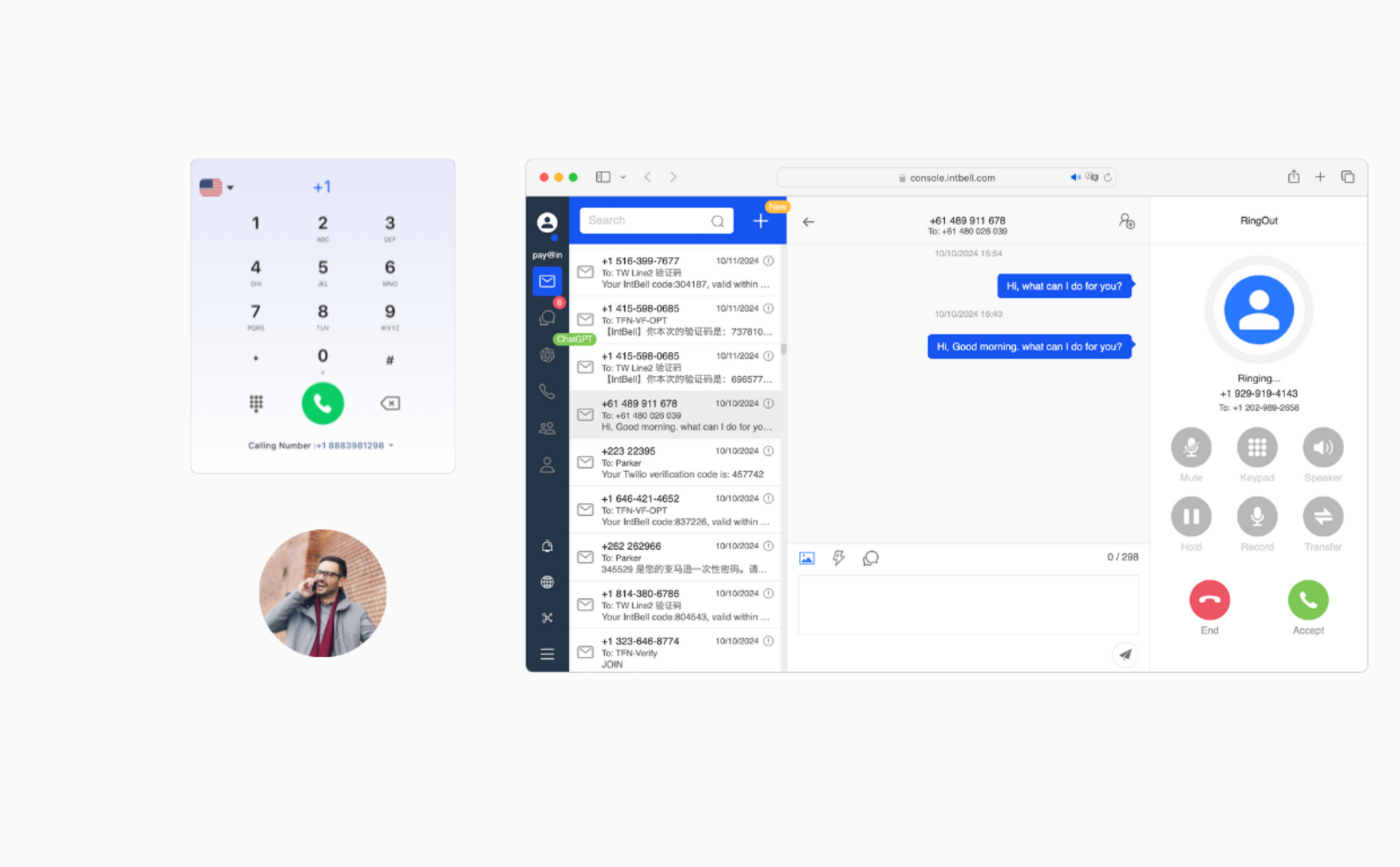
- Integrated Cloud Communication Platforms (e.g., IntBell): This is the core solution recommended in this article. Such platforms integrate all the aforementioned business functions and focus on serving enterprises’ global expansion needs. Essentially, they provide an “out-of-the-box” cloud PBX (Private Branch Exchange), packaging number application, call management, team collaboration, and data analysis into a standardized product.
The key reason to choose platforms like IntBell lies in integration and focus: Businesses do not need to switch between multiple fragmented tools (Tool A for calls, Tool B for SMS, Tool C for recording). All workflows can be completed within a single platform, greatly reducing management complexity and learning costs. Meanwhile, their technical architecture is fully optimized for the enterprise overseas expansion scenario—from global node deployment to ensure call quality, to feature design that aligns with international business practices, making them highly targeted.

How to Quickly Realize VoIP Value with IntBell?
For small businesses determined to upgrade their communication capabilities, we recommend the following implementation steps:
- Needs Self-Assessment: Clarify your main customer regions (e.g., North America, Europe), core communication scenarios (whether dominated by sales consultations or after-sales support), and the specific demand intensity for features like SMS and call recording.
- Priority Activation of Core Functions: After registration, prioritize applying for and setting up virtual local numbers—the fastest way to build a professional corporate image. Next, configure IVR voice navigation menus and call forwarding rules to ensure no business opportunities are lost.
- Deepen Business Process Integration: Based on your business workflows, enable two-way SMS for critical node notifications; turn on call recording to back up important negotiations and support team training; use data reports for regular analysis to optimize customer service hours and marketing strategies.
- Integrate into Team Culture Building: Incorporate clear, professional telephone etiquette and tool operation standards into daily team training. Let every call made through IntBell become a delivery of brand value.
Important Note: VoIP solutions focused on international business, represented by IntBell, have core value in solving cross-border communication challenges. If your business also involves a large volume of domestic calls, it is recommended to combine this solution with domestic communication services.